Category: Amplifier, Non Network Control Amplifier, Power Amplifier
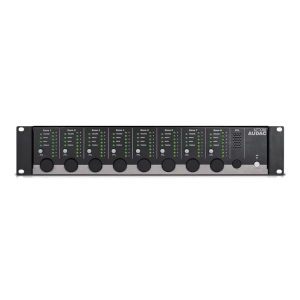
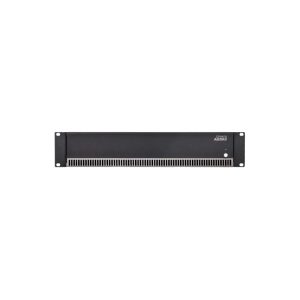
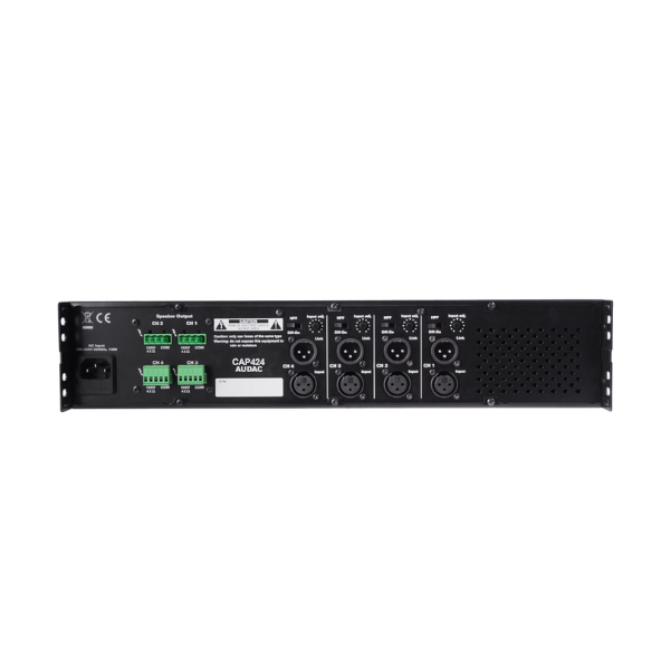
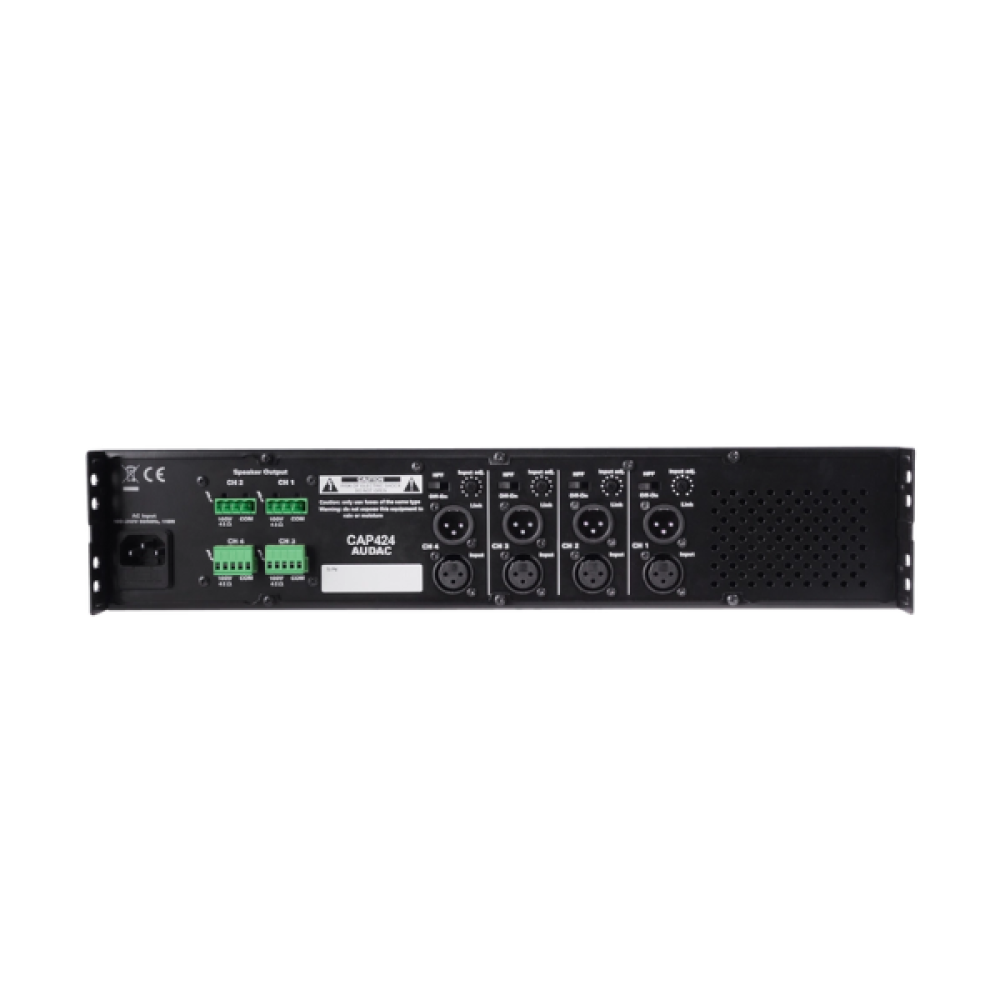
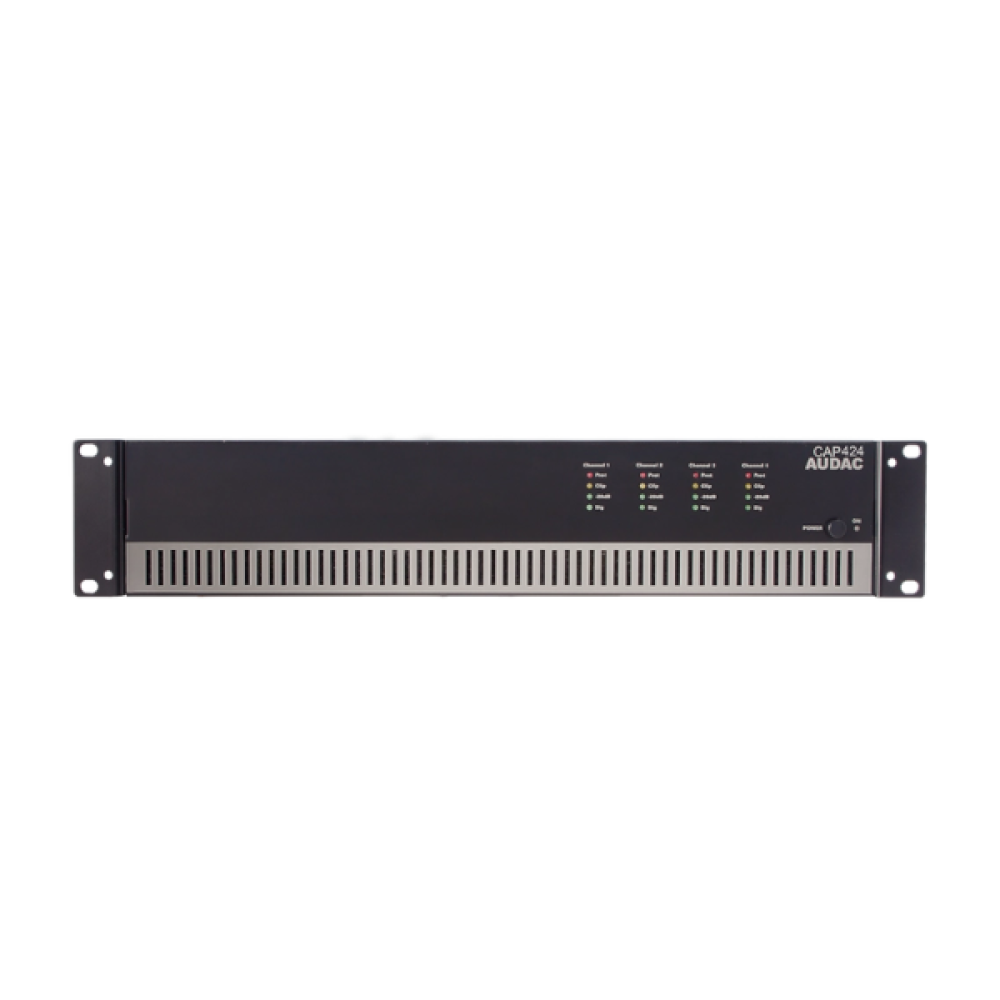
The CAP Series are professional 100V multi-channel power amplifiers, containing various models with different channels and different output power configuration. The CAP424 is a four channel version with an output power 240 Watt. This way, a flexible solution is created for multi-zone audio distribution systems with four zones. They are designed as no-nonsense amplifiers with only the necessary controls and connections which creates great simplicity in use and installation. A high efficiency and reliability of the devices is achieved by using switching power supplies in combination with Class-D amplifier technology. A temperature controlled FAN constantly keeps all parts within the right operation range, while avoiding excessive buzz. A built-in multipurpose protection circuit protects against DC malfunction, Short circuit, overheating, overload and limits the signal when necessary. The input connections are performed using balanced XLR connectors and Link output connectors are provided for link through to other amplifiers. Besides, a high-pass filter switch (400 Hz) and a gain adjustment potentiometer are provided for each channel. The output connections are performed using reliable terminal block connectors and this all is housed into a solid constructed, double rack space (2 HE) 19” rack mounting housing.
| Continuous power (AES) | 4 x 240 W | |
| Frequency | Response (± 3 dB) | 50 Hz – 22 kHz |
| Signal / Noise | > 100 dB | |
| THD+N (@ 1 kHz) | < 0.3% (1/2 Rated Power) | |
| Crosstalk (@ 1 kHz) | < 80 dB | |
| Technology | Class-D | |
| Power | Supply | Switching mode |
| Source | 230 ~ 240 V AC / 50 Hz | |
| Inputs | Sensitivity | -0.5 dB ~ 10.5 dB |
| Impedance | 10 kΩ balanced | |
| Connector | XLR female with Male Linkthrough | |
| Outputs | Voltage / Impedance | 100 V / 42 Ω |
| Connector | 4-pin Euro Terminal Block (Pitch – 5.08 mm) | |
| Common mode rejection ratio | 70 dB | |
| Protection | DC Short circuit | |
| Over heating | ||
| Over load | ||
| Signal limiting | ||
| Cooling | Temperature controlled fan | |
| Operating temperature | 0° ~ 40° @ 95% Humidity | |
| Dimensions | 482 x 88 x 420 mm (W x H x D) | |
| Weight | 8.350 kg | |
| Mounting | 19” | |
| Unit height | 2 HE | |
| Construction | Steel | |
| Colours | Black | |
| Accessories | Included | 4 x 4-pin Euro Terminal Block outputs connector |
| Optional | CPE100 Rack mount handles | |
|
Bars & Restaurants
|
|
Education
|
|
Corporate
|
|
Clubs
|
|
Retail
|
As the power consumption of an amplifier, strongly depends on how hard the amplifier is driven, measurements are provided for various loads: idle, 1/8 of average full power, 1/3 of average full power, and full power.
Idle
Current draw at idle or with very low signal level
1/8 Power: Pink Noise
Amplifiers are tested using pink noise signals to simulate real-world speech and music signals. It approximates operating with music or voice with light clipping and represents the amplifier’s typical “clean” maximum level, without audible clipping. This 1/8 power signal provides a very good approximation of how hard an amplifier would be driven by typical real-world speech/music signals, assuming those signals were being driven as loud as possible without clipping the amplifier.
1/3 Power: Pink Noise
1/3 Power Pink Noise is similar to 1/8 Power Pink Noise, except that it is a significantly more powerful input signal. It approximates operating with music or voice with very heavy clipping and a very compressed dynamic range. This 1/3 power signal provides an approximation of how hard an amplifier would be driven by typical real-world speech/music signals, assuming those signals were being driven loud enough to clip the amplifier heavily, and produce severe, audible distortion.
Full Power
Current draw at full power is measured with a sine wave at its maximum possible level. However, it does not represent any real-world operating condition and represents the absolute extremes that an amplifier could ever experience.
Heat dissipation is the process by which electronic devices like amplifiers and processors release the heat they generate during operation to prevent overheating. This data is important because it ensures devices perform efficiently, last longer, and are safe to use. To calculate heat dissipation, you measure the device’s power consumption (in watts) and use the thermal resistance (how well the device transfers heat) to determine how much heat needs to be managed. This information helps design proper cooling systems, ensuring the device remains within safe temperature limits.
The heat dissipation list for all Audac devices is in the link below.
Select at least 2 products
to compare